
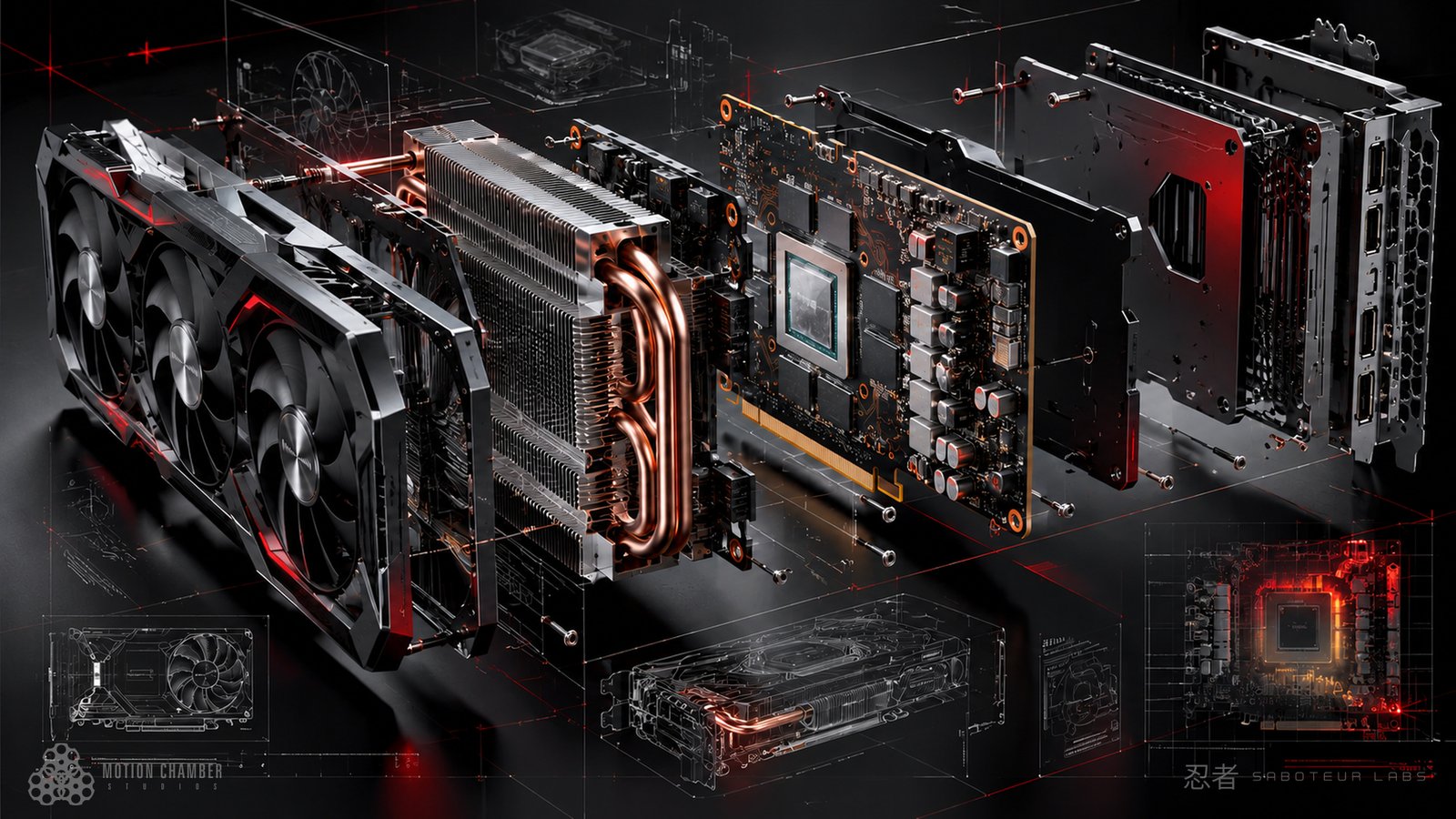
As AI, 3D, spatial computing and real-time media converge, the graphics card is no longer just a rendering component. It is becoming the local production floor.
For years, the graphics card had a relatively clear job: render pixels faster.
That definition is collapsing.
A modern GPU can now sit at the center of image generation, video restoration, 3D rendering, simulation, spatial computing, game development, local inference and increasingly complex creative pipelines. The same piece of hardware that once accelerated a viewport is becoming the machine behind the machine.
At Saboteur Labs, that changes how we think about hardware.
A GPU is no longer simply a component inside a workstation. It is an operating constraint, a production environment and, in some cases, the difference between an idea being theoretically possible and practically usable.
VRAM has become particularly important. More memory does not simply mean larger images or prettier renders. It determines how much of a model, scene, video sequence or computational workflow can exist in memory at once. When that ceiling is low, the workflow becomes a negotiation: tile the image, split the video, reduce the model, simplify the scene, move something elsewhere.
When the ceiling rises, the architecture changes.
That matters across several areas we are actively exploring.
Local AI workflows can keep increasingly capable models close to the production environment rather than treating every operation as a remote service. Video restoration and enhancement become more practical. Complex ComfyUI graphs can remain intact instead of being divided around memory limitations. Unreal Engine scenes can become richer. Spatial assets can be developed at higher fidelity before being aggressively optimized for their final destination.
And that last distinction matters.
The goal is not to throw maximum compute at everything.
A Meta Quest headset, a browser-based WebXR experience and a workstation running local AI have radically different performance envelopes. The interesting work happens in the relationship between them.
Build heavy. Test intelligently. Reduce deliberately. Deliver light.
A detailed object might begin as a dense 3D model, move through local AI-assisted texturing or restoration, become a carefully optimized asset, then arrive in a Three.js environment as something dramatically smaller and faster than its source.
The user never sees that pipeline.
They only experience the result.
That is where the graphics card becomes more interesting than its specification sheet. It becomes part of a larger system for moving ideas between physical design, artificial intelligence, real-time rendering and spatial experience.
The GPU is still rendering pixels.
It just happens to be rendering an increasingly large part of the future around them.