
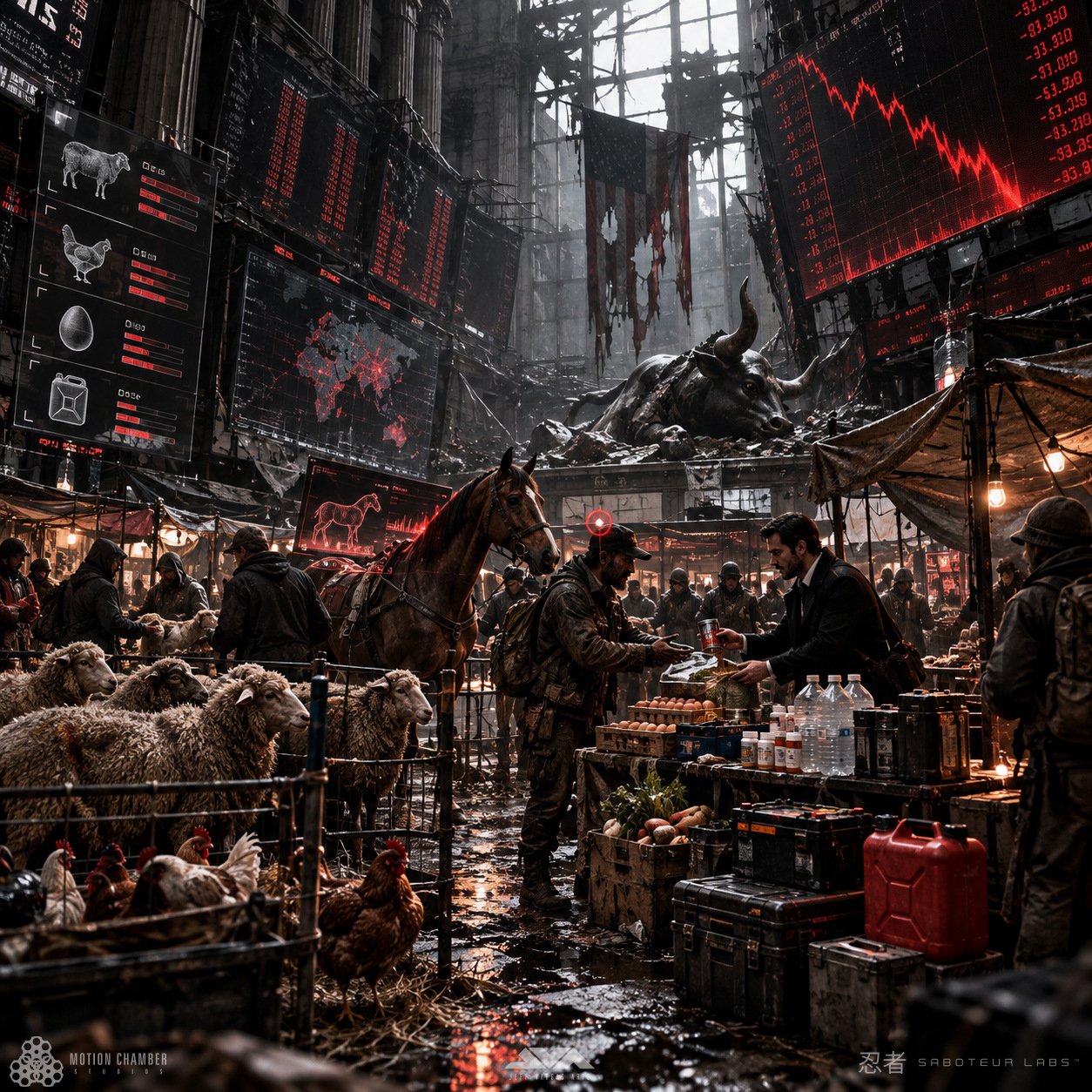
Money died. The market got promoted.
By Fuse — Experimental Interface Engineering & Web Systems
At 9:30 a.m., the opening bell rang on Wall Street for the first time in six months.
Nobody cheered.
The bell was connected to a car battery, the trading floor smelled like livestock, and someone had converted the executive dining room into a chicken hatchery.
It was, by most measures, the most productive day the exchange had seen in years.
The dollar was worthless. Credit cards had become extremely small ice scrapers. Cryptocurrency investors were still explaining decentralization to people who desperately needed drinking water.
But commerce?
Commerce was doing just fine.
A woman exchanged antibiotics for a solar inverter. A mechanic repaired a generator in return for six chickens. A former investment banker offered strategic consulting services in exchange for two eggs.
He received neither.
THE PROBLEM WITH CHICKENS
Barter sounds beautifully simple until you try to scale it.
You have a horse. I have batteries. You need medicine. I need fuel. The pharmacist wants eggs, and the farmer refuses to part with his chickens because he’s convinced they’ll appreciate in value.
They probably will.
Suddenly, what began as a straightforward exchange has become a logistical nightmare involving seventeen people, three neighborhoods, and an extremely uncooperative goat.
Society has rediscovered the fundamental problem that money was invented to solve.
And because society apparently learned nothing from the previous collapse, someone proposes a technological solution.
ENTER THE ENGINEERS
The first version was innocent enough.
A refurbished laptop. A local network. A spreadsheet containing available supplies, requested supplies, and completed exchanges.
Someone built a matching algorithm.
Someone else added geographic availability.
Then came dynamic valuation, transaction histories, reputation scoring, and predictive scarcity modeling.
Within two weeks, the barter network had a name.
EXCHANGE 2.0
Its developers insisted it wasn’t a bank.
There were no accounts containing money. No interest rates. No traditional currency.
Just a remarkably sophisticated system for determining how much your possessions, labor, and time were worth relative to everyone else’s.
The developers were very proud of this distinction.
THE NEW CURRENCY
Initially, the software performed admirably.
It connected people who needed medicine with people who had medicine. It optimized delivery routes. It reduced wasted food and helped communities identify critical shortages.
For a brief, beautiful moment, technology appeared to be making the world genuinely better.
Then somebody added a priority system.
Emergency requests received higher rankings. Reliable traders received better exchange recommendations. Participants with scarce inventory gained negotiating advantages.
All reasonable features.
All defensible design decisions.
And together, they introduced something that looked remarkably familiar.
A hierarchy.
People with resources acquired better reputations. Better reputations improved their access to resources. Better access made acquiring additional resources easier.
The system wasn’t corrupt.
That was the unsettling part.
It was functioning precisely as designed.
PLEASE RATE YOUR TRANSACTION
Soon, a farmer discovered that his chickens were worth more when the network anticipated a protein shortage.
A technician learned that delaying repairs increased the algorithm’s estimated value of his services.
One merchant began hoarding medical supplies because artificial scarcity produced better exchange ratios.
Someone suggested regulating the marketplace.
Someone else proposed introducing exchange credits.
An engineer recommended a distributed ledger.
The entire trading floor groaned.
Three weeks after the collapse of civilization, humanity had successfully reinvented speculation, market manipulation, credit scoring, and a technology startup.
Without a single dollar changing hands.
THE MOST VALUABLE THING IN THE ROOM
Eventually, the marketplace discovered that the most valuable resource wasn’t food, medicine, fuel, or livestock.
It was access.
Access to inventory. Access to transportation. Access to trusted suppliers. Access to the information needed to make a favorable exchange.
The people controlling the exchange infrastructure didn’t need to own the chickens.
They controlled who could trade them, who could see them, and which offers appeared first.
They weren’t merchants.
They were the platform.
And once the platform became essential, it started collecting a small fee for maintaining the system.
Not money, of course.
A percentage of goods exchanged.
Strictly for operational sustainability.
BUSINESS AS USUAL
By the end of the first year, the exchange had become the most powerful institution in the region.
It maintained the records, calculated relative value, verified transactions, resolved disputes, and controlled access to the marketplace.
Its administrators lived comfortably.
Its infrastructure was considered indispensable.
Its users complained constantly but couldn’t imagine leaving.
The new economic system was hailed as a triumph of human resilience.
A complete break from the financial structures that had failed civilization.
One afternoon, an elderly trader approached the exchange’s chief architect.
He looked at the terminals, the livestock, the people arguing over exchange rates, and the administrators collecting their percentages.
Then he asked a question.
“So what exactly changed?”
The engineer considered this carefully.
“We don’t use money anymore.”
The old man nodded.
“And what do you call the people who control everything?”
There was a long silence.
Somewhere overhead, the opening bell rang.
The engineer adjusted his glasses.
“We’re working on the branding.”
SABOTEUR LABS
Serious Technology. Questionable Behavior.
The money is gone. The market isn’t.