
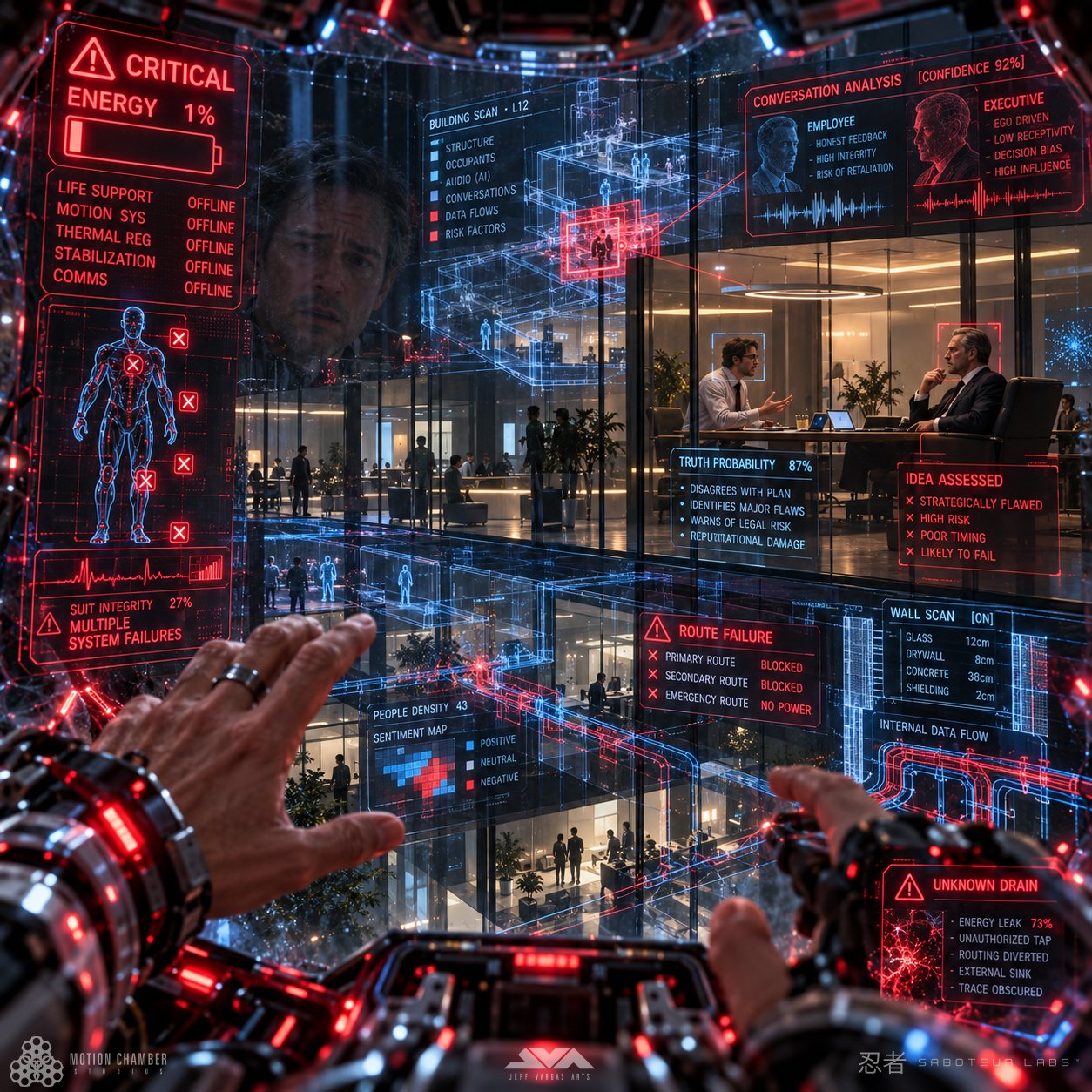
Everything is visible. Almost nothing is understood.
The interface has discovered something interesting.
Behind several walls, across multiple floors of a magnificent technological institution, an employee is attempting to explain to his superior that an idea is fundamentally flawed.
The employee has evidence.
The executive has authority.
The system has telemetry.
Everyone is performing exactly as expected.
Our operator observes the encounter through a sophisticated augmented interface capable of examining structural boundaries, identifying occupants, analyzing conversations, and estimating behavioral responses.
The employee’s assessment is accurate.
The executive’s confidence is high.
Unfortunately, those measurements are not mutually dependent.
The organization’s decision-making process has reached an impasse.
Or, as management might describe it, an opportunity for alignment.
The interface continues collecting information.
It identifies inconsistencies, evaluates strategic weaknesses, calculates reputational exposure, and produces an increasingly elaborate representation of the problem.
The information is extraordinary.
The problem remains untouched.
This is one of the more entertaining contradictions of modern technological civilization.
We have developed systems capable of observing almost everything while remaining remarkably selective about what we are willing to acknowledge.
We measure sentiment.
We measure productivity.
We measure engagement.
We measure the velocity with which information moves through an organization.
We have even developed the ability to estimate how confidently somebody might be wrong.
And still, somewhere inside the building, an employee must decide whether telling the truth is worth the consequences.
The interface cannot make that decision for him.
Neither can the dashboard.
The dashboard can only record what happens next.
Perhaps the executive will reconsider.
Perhaps the employee will be promoted.
Perhaps the entire organization will celebrate the value of transparent communication and courageous leadership.
Or perhaps the employee will be invited to participate in an exciting opportunity elsewhere.
The system assigns the interaction a confidence score.
A remarkable achievement.
Meanwhile, our observer remains trapped inside his malfunctioning suit, watching the machinery of institutional decision-making unfold in exquisite analytical detail.
His battery is nearly empty.
He understands more than ever.
He controls almost nothing.
Welcome to the ride.
Please keep your hands inside the vehicle.
Saboteur Labs — Experimental Editorial / Institutional Interfaces