
Some problems cannot be solved by thinking harder.
He has everything.
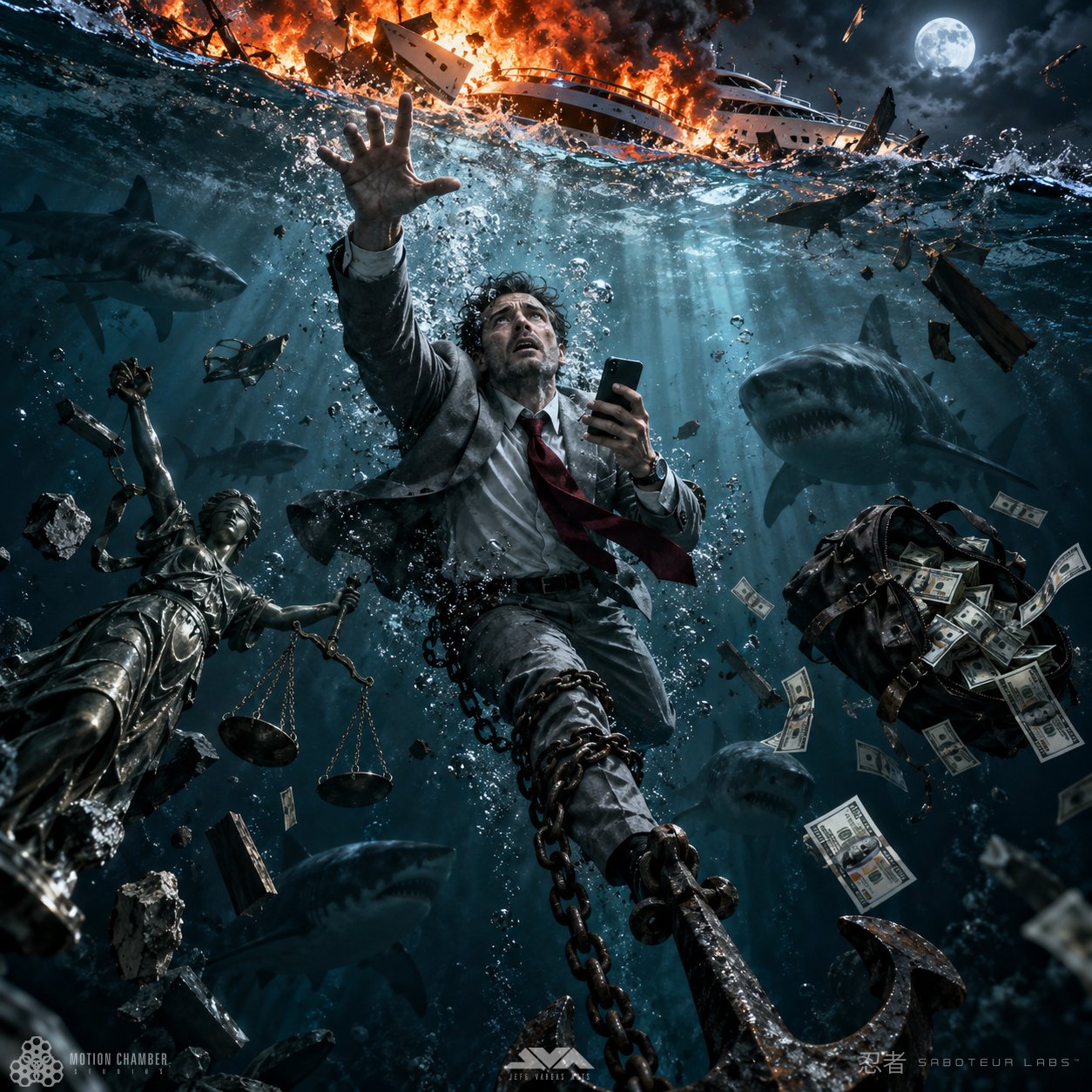
The suit. The watch. The money. The yacht. The phone. The extraordinary confidence that somewhere, somehow, somebody will pick up.
Unfortunately, he also has an anchor.
And the anchor is winning.
Above him, the yacht burns. Around him, sharks conduct their own assessment of the situation. The money is escaping faster than he is. Lady Justice has joined him underwater, although she appears considerably less concerned about the outcome.
His phone remains in his hand.
He is attempting to contact emergency services.
There is something extraordinary about a man who believes he can negotiate with physics.
We have built an entire culture around the assumption that intelligence, wealth, influence, and connectivity can overcome almost any obstacle. Problems become challenges. Catastrophes become opportunities. Risk becomes a performance metric, preferably displayed in green.
Until something stops cooperating.
Gravity, for example.
Or water.
Or an anchor attached to your leg.
The modern executive is surrounded by systems designed to produce confidence. Dashboards communicate certainty. Advisors translate danger into manageable language. Technology provides immediate access to information, assistance, and reassurance.
Everything has an interface.
Even disaster.
But an interface is not a solution. A notification is not an intervention. And being able to contact someone does not mean they can change the outcome.
The gentleman in our illustration has one remaining problem: he has mistaken the ability to initiate a process for the ability to control its conclusion.
He’s still thinking.
He’s still calculating.
He’s still reaching upward toward the surface.
The anchor, meanwhile, has no strategy, no quarterly objectives, and no interest in his credentials.
It simply performs its function.
Perhaps that is the most uncomfortable part of the picture.
The systems we build to elevate ourselves do not necessarily follow us when we fall.
Sometimes they are the things pulling us down.
And sometimes, despite an extraordinary amount of thinking, we discover that we should have learned to swim.
Welcome to the bottom.
Saboteur Labs — Experimental Editorial / Human Systems