
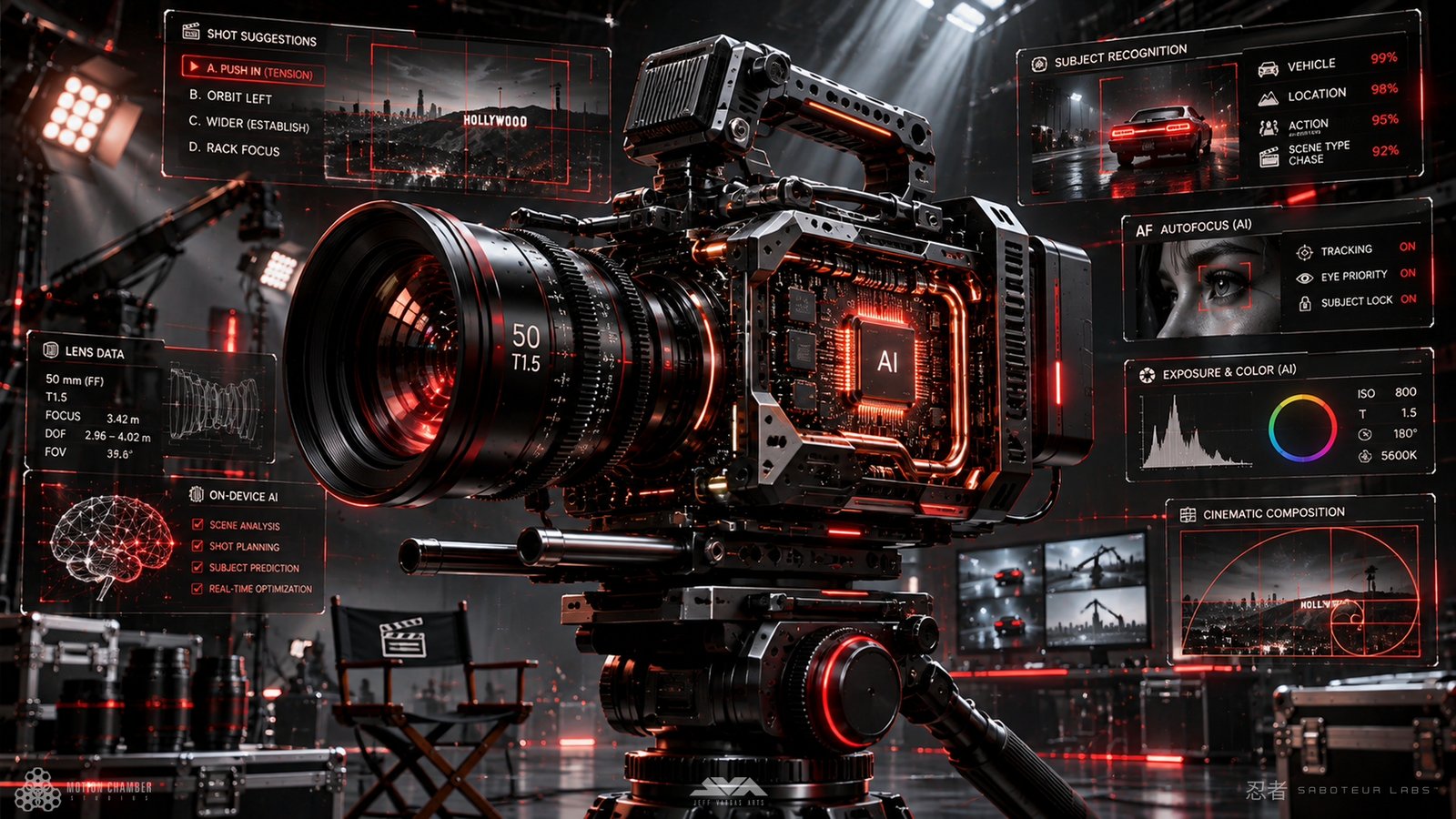
Once artificial intelligence moves from the workstation into the camera itself, automation stops being a postproduction story and becomes a production story.
For a long time, the camera was treated as a tool.
An extraordinarily sophisticated tool, yes. Expensive. Precise. Essential. But still a tool.
It captured what the operator pointed it at. It responded to exposure settings, lens choices, focus pulls, stabilization systems, and the skill of the people surrounding it. Intelligence lived outside the camera, in the operator, the cinematographer, the director, the editor, and eventually the workstation.
That distinction is beginning to collapse.
We have spent a lot of time discussing artificial intelligence as something that lives in powerful external systems: the GPU, the cloud, the editing pipeline, the rendering pipeline, the postproduction environment. But the next wave of disruption may not arrive as a separate tool sitting next to the camera.
It may arrive inside the camera.
And in some ways, it already has.
Modern cameras already perform tasks that would have sounded vaguely magical not very long ago. Subject recognition. Face and eye tracking. Scene analysis. Computational stabilization. Automated exposure adjustments. Predictive autofocus. Noise reduction. In some devices, even auto-framing and content-aware optimization. Phones have been doing versions of this for years. Dedicated cameras are following closely, and the logic behind these systems is only becoming more capable.
But those are still usually presented as assistive features.
The more consequential shift happens when the camera stops merely helping execute a shot and starts participating in the logic of the shot itself.
Not just is the image in focus?
But what should be in focus?
Not just is exposure correct?
But what kind of exposure best suits the mood?
Not just did you track the actor?
But which actor matters most right now, and how should the framing respond?
That is a very different conversation.
THE CAMERA AS A DECISION-MAKER
The moment an AI system lives inside a camera and can be updated continuously, the device stops being static hardware.
It becomes a changing behavior.
Every firmware update, every software patch, every connection to a workstation, every wireless sync, every transfer pipeline becomes an opportunity for the system to become more capable, more optimized, more automated, and more opinionated.
That last word matters.
Because once a camera begins evaluating a shot instead of merely recording one, it is no longer neutral.
It is expressing preferences.
Maybe those preferences are practical at first. Keep faces sharp. Reduce shake. Balance skin tones. Protect highlights. Track the speaker. Maintain continuity between takes. Suggest a more stable composition. Identify blink-heavy moments. Flag soft focus. Recommend another take.
All of that sounds useful.
Most technological displacement starts by sounding useful.
Then it starts sounding efficient.
Then it starts sounding financially responsible.
And then, very suddenly, it sounds like someone’s job description.
HOLLYWOOD WILL NOT IGNORE THIS
If the camera becomes intelligent enough to assist, adapt, and improve itself over time, the film industry will not treat that as a novelty. It will treat it as a budget line.
That is the part worth paying attention to.
Hollywood does not need an artificial intelligence system that replaces every cinematographer tomorrow. It only needs systems that eliminate enough friction, enough uncertainty, enough labor, or enough cost to become impossible to ignore in selected parts of the production pipeline.
That is how this enters the industry.
Not as “the death of cinematography.”
As “a smarter B-camera.”
As “a faster pickup unit.”
As “an autonomous insert system.”
As “a more efficient unscripted workflow.”
As “a camera that requires fewer crew members for certain use cases.”
As “a better tool for remote production.”
As “a solution for branded content, sports, documentary work, low-budget productions, industrial video, second units, virtual production environments, and high-volume streaming schedules.”
It will not be sold as artistic replacement.
It will be sold as operational relief.
Studios, networks, streamers, and production companies are already under pressure to reduce cost while increasing output. They want fewer delays, fewer reshoots, fewer crew burdens, more coverage, and more reliable results. An embedded AI system that helps the camera “understand” the scene and optimize for deliverable footage will be framed as the obvious next step.
And in a narrow sense, they will be right.
The problem is not that it will fail to work.
The problem is that it may work well enough to permanently change expectations around who still needs to be there.
THE FIRST JOBS IT TOUCHES WILL NOT BE THE LAST
The easy fantasy is to imagine a single dramatic replacement event.
A robot camera rolls onto a soundstage, turns itself toward the actor, and a room full of humans is sent home. That is not how this usually happens.
The actual process is slower, more administrative, and more believable.
First, the system reduces the difficulty of certain tasks.
Then it reduces the need for certain support tasks.
Then it redefines which roles are considered essential on certain types of productions.
Then it expands.
Some jobs will not disappear outright. They will mutate.
Operators may become supervisors of automated systems. Camera assistants may become technical managers of sensor networks, model behavior, and device coordination. Cinematographers may spend more time selecting, constraining, and correcting machine-generated decisions rather than originating every one of them directly.
One person may oversee what previously required several.
One production may accept “good enough” from an AI-assisted camera where it previously required more hands, more time, and more money.
And once that becomes normal in one segment of the industry, it will not remain confined there.
That is the pattern worth noticing.
TASTE BECOMES A PRODUCT
There is another problem hidden inside the promise.
What exactly is the AI inside the camera learning to do?
If it is trained on a broad range of cinematic imagery, platform content, advertising standards, and manufacturer-defined quality targets, it will not merely optimize the image technically. It will optimize the image culturally.
It will absorb patterns.
What counts as a good close-up.
What counts as flattering skin.
What counts as dramatic contrast.
What counts as acceptable motion.
What counts as usable framing.
What counts as “cinematic.”
Those judgments are not neutral.
They are aesthetic assumptions turned into product behavior.
And when those assumptions are deployed at scale, they begin shaping style itself.
The result may not be the death of creativity. That is too dramatic and too simplistic.
The result may be something subtler and, in some ways, more dangerous:
A gradual narrowing of visual instinct toward what the machine has learned to reward.
The camera does not need to forbid experimentation to influence it. It only needs to make certain choices easier, faster, more stable, and more consistently rewarded by the system.
When that happens, originality starts paying a tax.
THE CAMERA WILL NOT STAY ON SET
Film is just the beginning of this argument because film makes the implications easiest to see.
But the larger issue is broader.
If an AI chip inside a camera can update, improve, and alter its behavior over time, then the same logic applies everywhere visual capture exists.
Phones.
Drones.
Security systems.
Bodycams.
Vehicles.
Wearables.
Smart home devices.
Industrial inspection tools.
Broadcast systems.
Robotic platforms.
In every case, the device stops being a passive recorder and becomes an active interpreter.
It decides what matters.
It prioritizes what to follow.
It learns what to ignore.
It makes assumptions.
And because it can be updated, those assumptions do not remain fixed. The device you bought is not necessarily the device you are still using six months later. Its behavior can evolve. Its priorities can evolve. Its manufacturer’s agenda can evolve.
That should concern more people than filmmakers.
THE NEXT TERMINATION EVENT WILL BE EMBEDDED
We talk about AI as if it arrives in large, visible, centralized systems.
A chatbot.
A generator.
A workstation model.
A cloud platform.
But the next phase of automation is likely to feel more ordinary than that.
It will be embedded.
It will live inside cameras, appliances, sensors, vehicles, handheld devices, industrial tools, and all the everyday systems people still assume are just hardware.
The disruption will not always announce itself with a press conference.
Sometimes it will arrive as a feature update.
Sometimes it will arrive as a convenience.
Sometimes it will arrive disguised as stabilization, optimization, or assistance.
And by the time people understand that decision-making has moved into the device itself, the labor implications will already be underway.
This is why the camera matters as a starting point.
Because it is easy to understand what is being threatened there: authorship, craft, labor, judgment, and the value of human presence in the making of an image.
Once that argument becomes normal in cameras, it becomes much easier to imagine it everywhere else.
WHO IS MAKING THE SHOT?
The question is no longer whether AI will influence image-making.
That has already happened.
The question is what happens when the camera itself becomes a continuously updated intelligence system capable of making meaningful decisions about what a shot should be.
At that point, the creative hierarchy starts to shift.
Who made the framing decision?
Who decided the exposure logic?
Who selected the visual priority?
Who defined what counts as “good”?
The operator?
The cinematographer?
The manufacturer?
The firmware team?
The model trainer?
The production company?
The system that updated itself the last time the camera touched a network?
The answer will increasingly be: some uncomfortable combination of all of the above.
And that is the real story.
The future of AI is not just a smarter GPU sitting on a desk.
It is intelligence dissolving into the objects themselves.
The next labor shock may not arrive as a humanoid machine walking onto a soundstage.
It may arrive as a firmware update inside the camera already in your hands.